
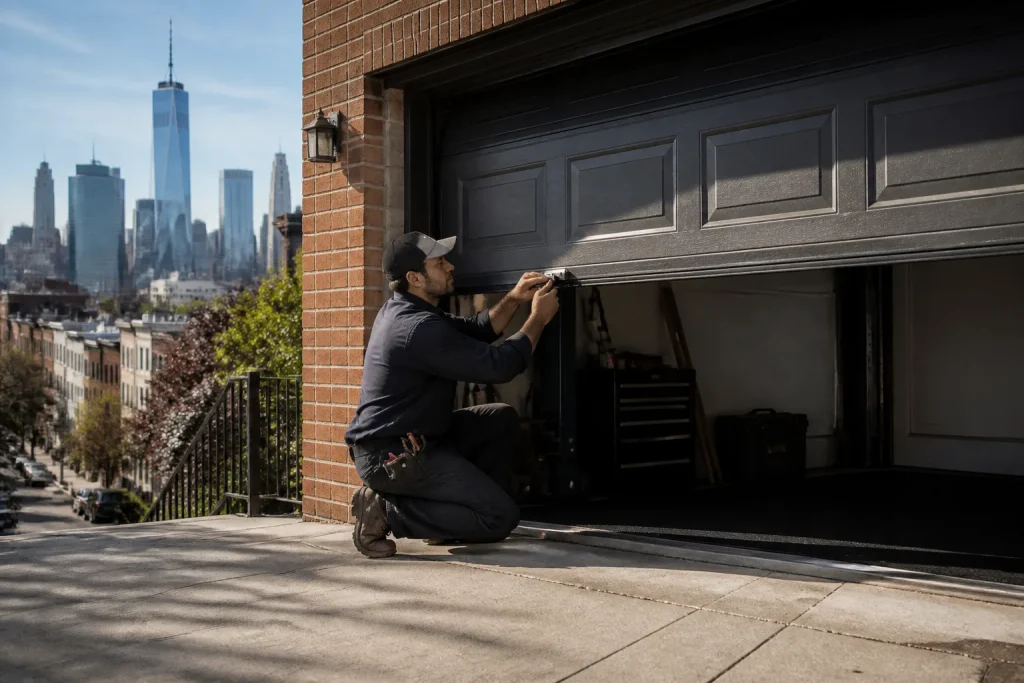
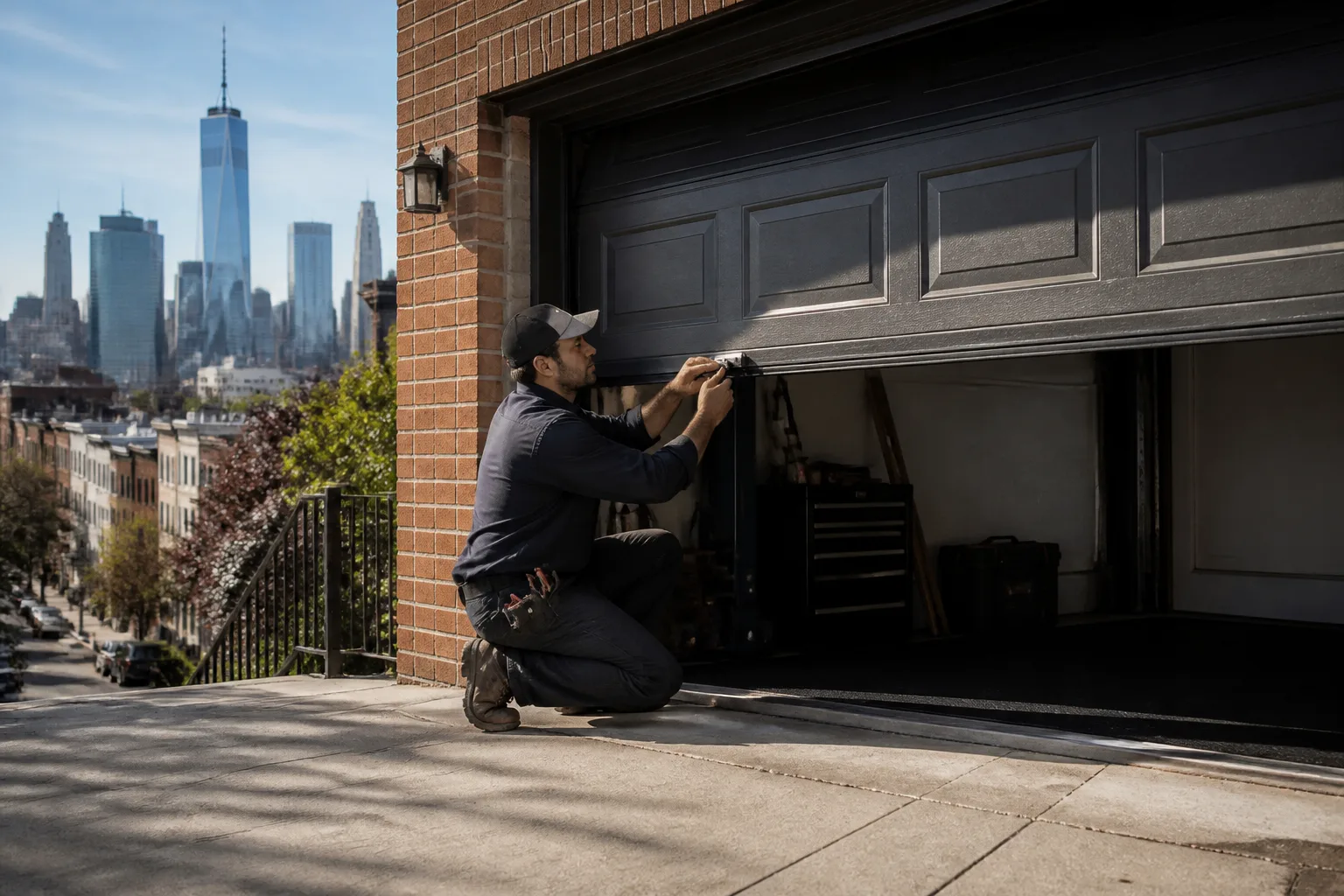
Garage Door Repair Cost Guide: What New York City Homeowners Pay in 2026
Garage door repair in New York City typically runs $180 to $480 for most common fixes in 2026, but that number hides a lot. The real story is that NYC homeowners pay 35 to 55 percent more than the national average for identical parts and labor, because borough labor rates, building access logistics, and insurance filing requirements stack costs that a national guide never sees. We’ll break down exactly what you should expect to pay, line by line, so you can read an invoice and know whether the number in front of you is fair. If you’d rather skip straight to a written price for your specific door, call (970) 536-1724.
What Garage Door Repairs Actually Cost in New York City
A spring replacement that runs $150 in Columbus costs $240 to $320 in Manhattan. The spring itself is nearly identical: a torsion spring with 0.225-inch wire and a 2-inch inside diameter costs the same amount from a supplier whether it ships to Ohio or Queens. What changes is everything around the spring. The technician’s van sits in paid parking or a loading zone that costs $40 for the hour. The building files a certificate of insurance 48 hours before the appointment, and a management office employee gets paid to process it. The technician bills at a New York City labor rate, which reflects commercial rent on the shop, commercial auto insurance in the five boroughs, and the cost of living that keeps a qualified technician accepting jobs here at all.
Here is the component-level breakdown for New York City in 2026, with parts and labor separated so you can see where your money goes. These ranges reflect what we write on quotes across Manhattan, Brooklyn, Queens, and the Bronx, and they assume a standard single-width residential door in working order except for the failed component.
- Torsion spring, single: $220 to $310 total ($60 to $90 parts, $160 to $220 labor)
- Torsion spring, double: $310 to $430 total ($120 to $170 parts, $190 to $260 labor)
- Extension spring pair: $140 to $200 total ($40 to $60 parts, $100 to $140 labor)
- Cable replacement: $140 to $210 total ($30 to $45 parts, $110 to $165 labor)
- Roller replacement, full set: $90 to $160 total ($25 to $40 parts, $65 to $120 labor)
- Opener motor replacement: $280 to $460 installed ($180 to $300 parts, $100 to $160 labor)
- Door panel replacement (single section): $350 to $600 depending on brand and material
- Track realignment: $110 to $180 total
Labor is the largest variable, and it moves with neighborhood density. A technician who can park a van directly in front of a single-family driveway in Riverdale bills less access time than one who has to unload through a service elevator in a Midtown high-rise and wait for the building’s freight hours. The same spring job can genuinely cost $70 more in a co-op with elevator-time restrictions than in a detached garage in Marine Park, and that difference is legitimate, not padding.
The NYC Cost Adders No National Guide Mentions
The national average for garage door repair was about $190 in 2025. That figure is a weighted blend of suburban single-family homes, Sun Belt sprawl jobs where the technician parks in the driveway, and rural service calls with short travel distances. New York City does not participate in that weighted blend. What adds cost here, beyond the borough labor rate, falls into three buckets that a generic cost guide never addresses.
First, building management coordination. If you live in a co-op or condo, your building likely requires the vendor to file a certificate of insurance naming the building, the managing agent, and sometimes the board as additionally insured. That filing takes time, sometimes 48 hours in advance of the appointment, and time is money. Some buildings charge a vendor access fee on top, and that line item lands on your invoice not because the garage door company invented it but because the building’s rules created it. Ask your contractor whether they handle COI filing directly, and ask your management office whether there is an access fee before you schedule, so neither number surprises you.
Second, elevator time charges. In multi-story buildings where the garage sits below grade or the door must be serviced from a shared loading area, freight elevator reservations may be required, and some buildings charge for the elevator operator’s time or require the job to happen within a narrow window. A 45-minute spring replacement plus two 15-minute elevator waits is not the same job as a driveway repair.
Third, New York City Department of Buildings permits. Most repair work on an existing garage door does not require a DOB permit: replacing a spring, cable, roller, or opener motor on an existing door is maintenance. But if the scope changes to structural work, a new door opening, or replacing the entire door on a landmarked building, a permit may be required, and that adds both cost and timeline. A limited alteration application commonly runs several hundred dollars in filing fees, and approval can add days to weeks. A company that tells you a full door replacement on a landmarked brownstone in Park Slope needs no permit is not doing you a favor.
How Written-Price-First Quoting Works, Mechanically
Clause 1 of The Haven Standard, the documented standard Servo operates under, is simple: a flat, written price and written scope are delivered before any work starts. No verbal ranges followed by a surprise invoice. No “we’ll see once we’re in there.” The quote document should contain four things, and you should ask for all four on any estimate in New York City.
- Part number: If the company quotes a torsion spring, the quote should identify the spring by wire diameter, inside diameter, and length. A 0.218-inch wire spring is not a 0.250-inch wire spring, and a company that won’t name the part on paper before ordering it is keeping room to substitute something cheaper.
- Unit cost: The parts line should show what the component costs. If the quote lumps parts and labor into one number, you cannot tell whether you are paying a fair labor rate or a padded parts markup.
- Labor rate: Shown separately, in dollars per hour or as a flat per-job labor figure. The flat figure is better for you, because it locks the labor cost regardless of whether the job takes 40 minutes or 90.
- Total: One number, written down, agreed before the technician touches the door. The total should not change unless a second failed component is discovered mid-job and is documented before additional work is approved.
We photograph the failed component before quoting a replacement, because Clause 4 of The Haven Standard says the customer sees the failed part before anyone quotes a replacement. The founding rule at Servo, since 2015, has been that evidence gets documented and delivered. A torsion spring with a clean break at the coil looks different from a spring with rust pitting and stretched coils, and your quote should reflect what the photograph shows, not what the technician tells you over the phone before seeing the door.
Three Invoice Line Items Where Padding Is Most Common
If you are reading an invoice from a New York City garage door company and something feels heavy, these are the three specific places to look.
The “service call fee” billed separately from labor. Some companies advertise a low labor rate and then add a $59 or $89 service call fee on top, which is just labor wearing a different name. Ask whether the service call fee is credited toward the repair or is an additional charge. In our quoting system, the price on the page is the price, and there is no separate trip charge materializing after the fact.
The “disposal fee” for a single spring or a pair of rollers. A torsion spring weighs eight pounds and fits in a five-gallon bucket. There is no landfill, no hazmat, and no special handling requirement for garage door components. A disposal fee on a residential repair invoice, especially one over $20, is padding unless the company is hauling away an entire door.
The “emergency surcharge” applied to a next-day appointment that isn’t an emergency. An emergency is a garage door that will not close, leaving the home open and unsecurable, at 9 p.m. on a Sunday. A spring replacement you schedule for Wednesday afternoon is not an emergency, and a company that applies a weekend or after-hours rate to a standard daytime appointment is billing urgency they didn’t provide. We answer calls 24/7 and dispatch for genuine emergency calls, and the emergency rate is quoted and agreed before the technician leaves, never discovered afterward.
What You Can Safely Check Yourself
Not everything requires a technician. A homeowner in New York City can check a few things without touching anything dangerous, and doing so will save you the diagnostic half of the service call if the fix turns out to be trivial.
Listen to the door. A grinding sound on a chain-drive opener often means the chain has slack and needs adjusting, a $90 to $130 fix. A quiet hum with no movement typically points to the opener’s logic board or capacitor, not the door itself. Check the photo eye sensors near the floor on both sides of the opening: if one blinks, the sensor is misaligned or blocked, and realigning it is a five-minute fix that costs nothing if you can nudge it back into position. Check the balance of the door by releasing the opener with the red cord and lifting the door manually to waist height. A door that stays put is balanced; a door that drops is not, and that points to spring wear.
Here is what you should not touch: torsion springs, cables, and anything under tension. A torsion spring under load stores enough force to cause severe injury or worse if it releases while you are working on it. The safety cables on extension springs exist because springs break and whip. We say this plainly because the cost of a spring replacement in New York City, $220 to $430, is a fraction of an emergency room bill, and no homeowner should open the spring bracket on a live door. When the spring is the problem, call a professional who works on springs daily.
Why the Written Price Protects You More Than the Warranty
The warranty matters, but in New York City, the written price matters more. A company can offer a lifetime warranty and still bill you for a second spring when the first one fails in nine months because the original invoice didn’t specify what was installed. The document is what makes the warranty enforceable. A written quote with the part number, the unit cost, and the labor rate is a paper trail that says exactly what you paid for and exactly what should be made right if it fails. The 365-Day Done Right Promise at Servo means if a repair is not right, we make it right, and the document is the basis for that promise. It is not a handshake; it is a terms page, and the terms are written down before the work starts.
That is also why we offer a Free Second Opinion on any written estimate from another company. Bring the paperwork. If it’s a quote for garage door repair in New York City, we’ll read it line by line and tell you whether the parts are correctly specified and the line items are honest. No coupon, no code, no catch. The documentation is the whole point.
When to Call a Pro
Call when the spring is broken, when the door will not close, when a cable has snapped, or when the door is off its track. These are not diagnosis-by-YouTube situations, and in an apartment building or a co-op, the consequences of a door that will not secure are not limited to your unit. A grounded door that blocks a shared garage entrance becomes a building problem, and the management office’s patience will run out faster than a technician’s schedule. If you are in New York City and your door is making a sound you haven’t heard before, or it’s binding on the way up, call (970) 536-1724 and describe what you are hearing; we’ll tell you whether it sounds like a spring, a roller, or an opener board, and what it likely costs before you commit to a visit.
Related services in New York City: garage door repair, garage door installation, and garage door opener repair and installation.
The Bottom Line
Garage door repair in New York City costs more than the national average for legitimate reasons: borough labor rates, building access logistics, insurance filing requirements, and the occasional DOB permit. The national median is not your number, and the only reliable number is the one written on a quote that names the exact part, shows the unit cost and labor split, and is delivered before any work begins. If you are reading an invoice with a mystery service call fee, a disposal charge for a single spring, or an emergency surcharge on a weekday appointment, ask to see the line-item justification. When you are ready for a written price on your specific door, Servo Garage Doors offers free estimates and a documented photo record on every visit. Call (970) 536-1724.
Frequently Asked Questions
A single torsion spring replacement in New York City runs $220 to $310, and a double spring replacement runs $310 to $430, including parts and labor. The higher number reflects NYC labor rates and building access logistics, not a higher spring price. Call (970) 536-1724 for a written quote with the exact spring size and cost before any work starts.
Most repair work on an existing garage door, including spring, cable, roller, and opener replacement, does not require a DOB permit. A permit is typically required only for structural changes, new door openings, or full replacements on landmarked buildings. Ask your contractor to confirm permit requirements in writing before scheduling.
For genuine emergencies, like a door that will not close and leaves the home unsecure, Servo dispatches same-day in New York City with a live person answering the phone 24/7 and a named technician sent with an on-the-way text. You’ll get the emergency rate quoted and agreed before the technician leaves, not discovered on the invoice.
Not at Servo. The price is written, the scope is written, and both are agreed before any work starts. If the technician finds a second failed component mid-job, it is photographed, documented, and approved by you before any additional work proceeds. Clause 1 of The Haven Standard is a flat, written price before work begins, with no exceptions.
Written by Marcus Deller, Owner at Servo Garage Doors, serving New York City since 2015.
Need Garage Door Help?
Call Servo Garage Doors - licensed & insured, here with fast after-hours help in Los Angeles.
(970) 536-1724